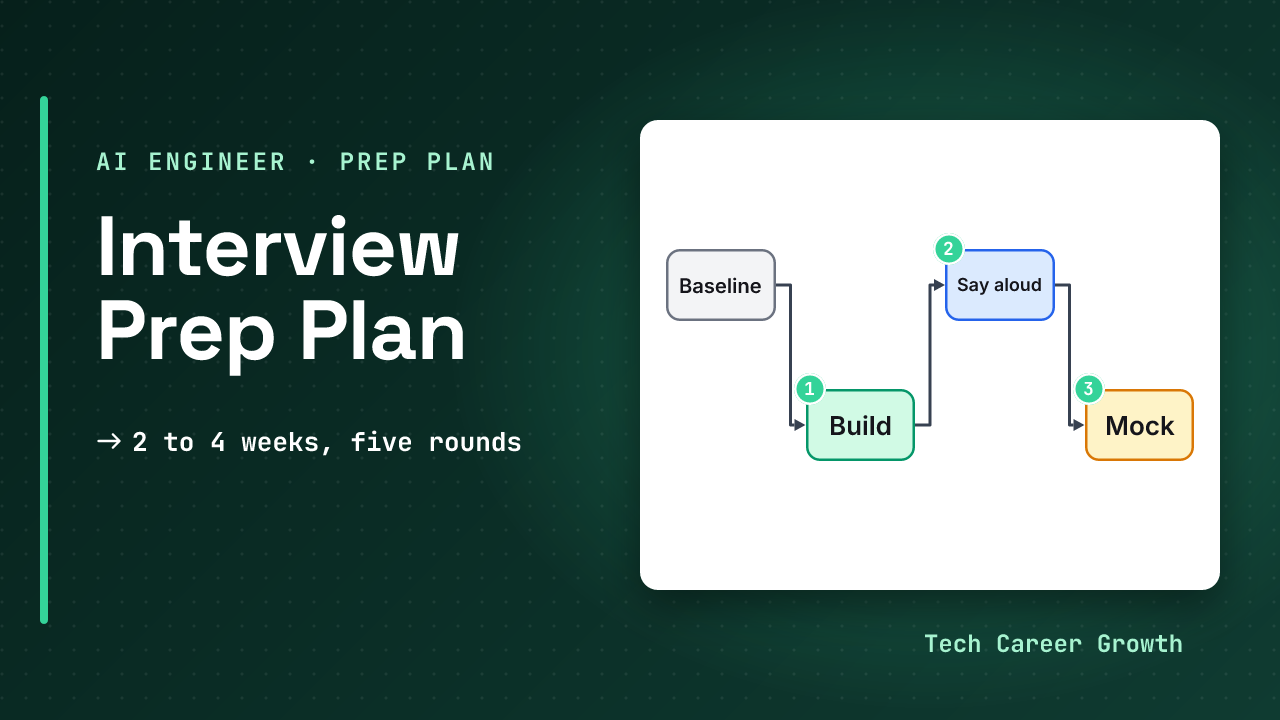
Three weeks until the interview. Forty browser tabs open. A list of topics that grows each time a new post goes by. The candidate studies whatever feels interesting and gets to the behavioral round on the last night.
The fix is not more material. It is an order, a rhythm and a way to check progress. This is Part 6 of the AI Engineer Interview Prep series and the plan for all of it: five tracks, two to four weeks, one weekly cycle. It builds on the lessons for RAG, agents, evals, portfolio projects and the behavioral round.
- You write Python and have called an LLM API.
- You know the date of your interview, or a rough guess.
What are the six steps of the two-minute project walkthrough? Problem, simplest design, one number, a failure, a decision, what comes next. The plan below makes sure you have a number and a failure to put in it.
- Start with a 30-minute baseline, so the plan fits your weak rounds, not an average candidate.
- Repeat one weekly cycle: learn, build and measure, say it aloud, mock and score.
- Saying answers aloud is the step people skip, and it is the one the interview actually tests.
- Cut builds before you cut mocks when time is short.
- Stop learning new topics in the last 48 hours. Rehearse what you already have.
Choose a two, three or four week plan, run the weekly cycle for each of the five tracks, score a mock interview, and know what to do in the last 48 hours.
What does a good plan have to do?#
It has to cover every track, fit your hours, and tell you each week whether you are improving. The interview hub lists five rounds: LLM fundamentals, RAG, agents, system design and behavioral. This plan keeps four of them and adds evals as its own track, because every round ends with “how do you know it works?”. Treat LLM fundamentals as a warm-up: skim it in week one and use it as spare review.
Two assumptions run through this lesson, and you should change them to match your life. First, about 10 hours a week: three sessions of about two hours for learning and building, three of about 45 minutes for saying answers aloud, and one mock of about an hour. Second, you keep your usual coding practice on top of that. If you have fewer hours, cut build time first.
Start with a 30-minute baseline#
Before choosing a plan, find out where you stand. Answer one question per track aloud for about five minutes each, without notes. Then mark each round red, amber or green.
Track       R / A / G
RAG         _
Agents      _
Evals       _
Sys design  _
Behavioral  _
Red means you stalled or guessed. Amber means you answered but missed the follow-up. Green means you could say it cleanly. Spend the most time on red rounds, and use green rounds as a warm-up.
Pick the plan that fits your weeks#
If your baseline is mostly red, add a week. If it is mostly green and you already have a measured project, you can run the two-week plan.
The four-week plan#
| Week | Focus | Do |
|---|---|---|
| 1 | RAG | RAG lesson, build and measure a hit rate, say the answer aloud |
| 2 | Agents | Agents lesson, write a guard loop, say the failure answers aloud |
| 3 | Evals and system design | Eval lesson, a 20 to 50 task set, system design lesson, README |
| 4 | Behavioral and mocks | Story bank, walkthrough, two full mocks, light last two days |
The three-week plan#
| Week | Focus | Do |
|---|---|---|
| 1 | RAG and agents | Both lessons, one build, answers aloud |
| 2 | Evals, system design, README | Golden set, design lesson, project README |
| 3 | Behavioral and mocks | Story bank, two mocks, light last two days |
The two-week plan#
| Week | Focus | Do |
|---|---|---|
| 1 | RAG, agents, evals | Question drills aloud, no new builds, use an existing project |
| 2 | System design, behavioral, mocks | Design lesson, walkthrough, one or two mocks |
For the two-week plan, a project you already have matters more than a new one. If you have none, build only the local RAG capstone and measure it. The hub’s two-week advice says to build a RAG-plus-agent project end to end. That fits two weeks only if building is most of what you do. This plan assumes you spend that time on answers aloud, because the interview tests speaking.
The weekly cycle#
Every week repeats the same four steps, whichever plan you chose.
- Learn. Read one round’s lesson and note the follow-up questions.
- Build and measure. Make one small change to your project and record one number.
- Say it aloud. Answer the round’s questions out loud, timed and recorded.
- Mock and score. Run a mock with a friend or a recording, and score it.
The score decides next week. If a round is still red, it gets more time than the schedule says.
What each week should produce#
Reading alone does not count as progress. Each week ends with something you can point to.
- RAG week: a hit rate on your own questions, before and after one change. The chunking lesson shows how.
- Agents week: a run where a guard fires. Anthropic notes that agents commonly include stopping conditions such as a maximum number of iterations, so show yours stopping a loop.
- Evals week: a golden set of real failures. Anthropic’s guide suggests 20 to 50 simple tasks to start, and a regression set that stays near 100%.
- System design week: one diagram you can redraw from memory, with your cost and delay levers named.
- Behavioral week: a two-minute walkthrough and four or five stories, timed.
If you cannot say it aloud in two minutes, you do not know it yet. Reading it again does not fix that. Saying it does.
How to run a mock interview#
Ask a friend, a colleague or a study partner to ask you one question per round and one follow-up. If nobody is free, record yourself and play it back. Use the same scorecard every time, so scores are comparable.
Opened with the problem?  y/n
Named a number + setup?   y/n
Named a failure + fix?    y/n
Handled the follow-up?    y/n
Finished within time?     y/n
Two or more “n” answers in a round means it goes back to red. Write down the follow-up you missed and add it to the next week’s list.
The last 48 hours#
Stop learning new topics. Anything new now will be half-learned and will make you anxious about what you do know.
- Re-read your failure log and story bank once.
- Say the two-minute walkthrough aloud twice.
- Run one light mock on your weakest round.
- Check the logistics: the link, the room, the tools, your questions for them.
- Sleep. It does more for recall than another hour of reading.
- Reading for a week and speaking for no hours.
- Practising only the round you already like.
- Starting a new build in the final week.
- Skipping the behavioral round until the last night.
- Doing no mock, so the first timed answer is the real one.
Put the sessions in your calendar as fixed appointments, with the round named. A session labelled “say RAG answer aloud, 45 min” gets done. A task called “prep” does not.
Fill this in, then put each line in your calendar:
Weeks left: __
Hours/week: __
Weakest round: __
Mon: ____
Pick a plan from the three above and write one session per day for the first week.
Hint
Expected output
The shape to aim for:
Weeks left: 3
Hours/week: 8
Weakest round: agents
Mon learn  Tue build
Wed aloud  Thu aloud
Fri mock Sat rest1.Why start with a baseline instead of the first lesson?
It shows which rounds are weak, so the plan spends its time there. Without it, you drift toward the rounds you already like.
2.You have two weeks and no project. What do you build?
Only the local RAG capstone, then measure a hit rate on your own questions. Use the rest of the time for answers aloud and one mock.
3.A mock scores three no answers in the agents round. What changes next week?
The agents round goes back to red and gets more time than scheduled. Add the missed follow-up to the list and repeat the aloud session.
4.It is 24 hours before the interview. Do you read one more topic?
No. Re-read your failure log, say the walkthrough aloud, and sleep. New material now is more likely to hurt than help.
In one picture#
Baseline  5 rounds, R/A/G
Plan      2, 3 or 4 weeks
Cycle     learn, build, say, mock
Rule      score picks next week
Last 48h rehearse, do not learn- RAG interview questions: week one for the four-week plan.
- AI agent interview questions: week two.
- LLM evaluation interview questions: proof for every other round.
- LLM system design interview: the design round.
- Behavioral interview: your two-minute walkthrough.
- AI engineer salary 2026: what to know before the offer stage.
This is the last lesson in the series. Pick your plan, put the first session in your calendar, and start with the baseline.