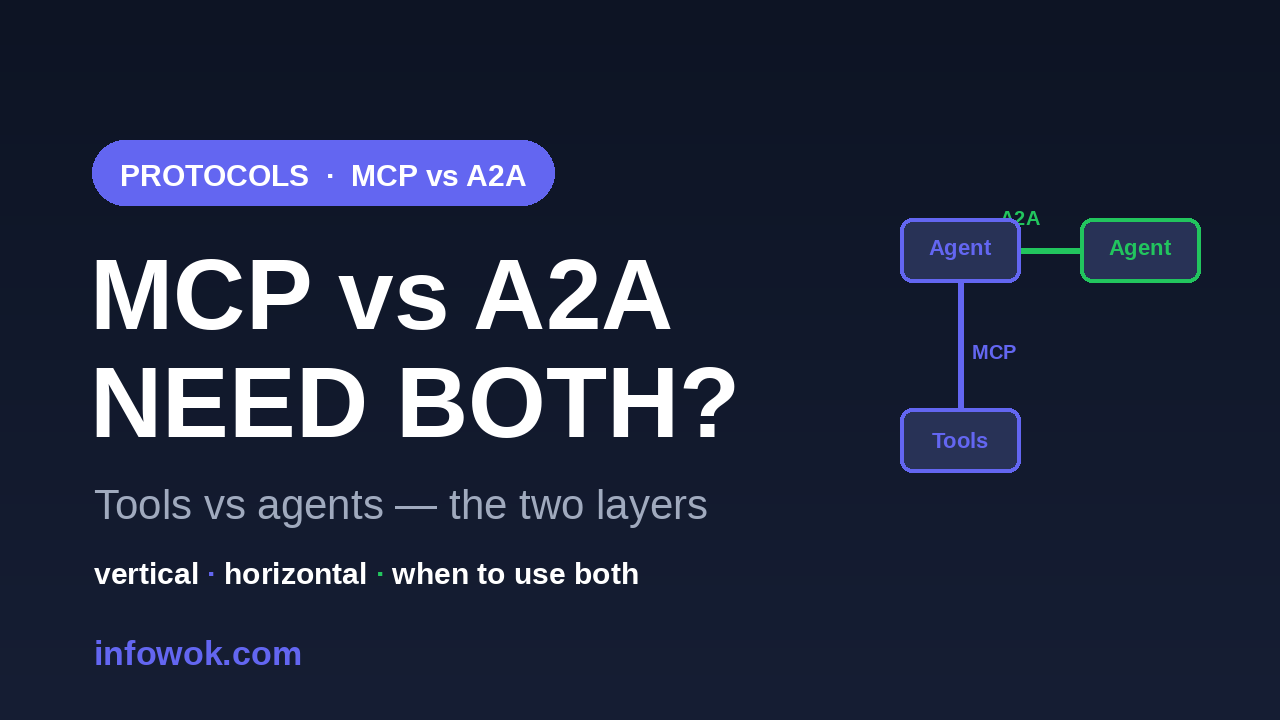
Everyone is suddenly adding A2A to their stack because Google and the Linux Foundation blessed it. For most of you building a single agent, it is a solution to a problem you do not have yet. That is the uncomfortable part nobody says out loud — so let me say it, then show you the exact signal that tells you when it changes.
This post answers MCP vs A2A without the whitepaper tone. By the end you will know what each protocol is for, why they are not really competitors, and whether you can safely ignore A2A for now. I have built single-agent apps that needed neither, and I have hit the wall where one agent simply cannot do the job alone. Both lessons are here.
- MCP and A2A are different layers, not competitors: MCP connects an agent to tools; A2A lets agents talk to other agents.
- For a single agent, A2A solves a problem you don’t have yet — MCP alone is usually enough.
- You need A2A once independent agents (often across teams or vendors) must coordinate as peers.
- Both became neutral standards in 2026, which is why they’re suddenly everywhere.
The two layers of the agent stack#
Start with the one idea that makes the whole debate click: MCP and A2A live at different layers, so they almost never compete for the same job.
MCP (Model Context Protocol — an open standard that connects an AI agent to tools and data) runs vertically. It is the wire from your agent down to a file system, a database, or the GitHub API. A2A (Agent2Agent — an open protocol for one agent to talk to another) runs horizontally. It is the wire from your agent across to a second agent that does its own separate job.
The diagram says it in one look. Each agent uses MCP to reach its own tools, and A2A only appears when two agents need to coordinate. If you have one agent, you live entirely on the vertical layer — and that is a perfectly complete app.
MCP vs A2A, side by side#
Here is the comparison I wish someone had handed me when these two acronyms started showing up in the same sentence. MCP gives an agent hands; A2A gives a team a shared language.
| MCP | A2A | |
|---|---|---|
| What it connects | One agent to tools and data | One agent to another agent |
| Direction | Vertical (agent → tool) | Horizontal (agent ↔ agent) |
| Core unit | A tool call | A task with a lifecycle |
| Who talks | Your agent and a server you trust | Two agents, often owned by different teams |
| You need it when | Your agent must do something | A separate agent must do part of it for you |
| Maturity in 2026 | Ubiquitous, default in every major client | Stable v1.0, growing fast, mostly enterprise |
Notice the last row. MCP is everywhere a single developer already works; A2A is real and stable, but its center of gravity is still multi-team and enterprise. For an indie developer in India shipping one agent, that maturity gap is the whole decision. You reach for MCP on day one and for A2A only when a second agent enters the picture.
What A2A actually adds#
When you do cross into multi-agent territory, A2A solves three problems that MCP was never designed to touch: discovery, messaging, and task coordination.
Discovery works through an Agent Card — a small JSON document an agent publishes at /.well-known/agent-card.json. It lists the agent’s name, what it can do, the input and output types it accepts, and how to authenticate. Think of it as a business card your agent can read before it decides to delegate. In A2A v1.0 these cards can be cryptographically signed, so you can verify an agent really is who it claims to be.
{
  "name": "Billing Agent",
  "description": "Handles invoices, refunds, and payment status",
  "url": "https://billing.example.com/a2a",
  "capabilities": { "streaming": true },
  "skills": [
    { "id": "refund", "name": "Issue refund", "inputModes": ["text"] }
  ]
}
That card is all another agent needs to find this one and call it. The actual work then flows as a task — A2A’s core unit. A task moves through a clear lifecycle: submitted → working → completed (or failed, or canceled). Messages carry the back-and-forth while the task runs, and the final outputs come back as artifacts. This is the part MCP genuinely cannot do: MCP calls a tool and returns once, while A2A models a longer conversation between two independent agents.
The key distinction: an MCP tool call is a single round trip. An A2A task is a relationship with a status you can poll, stream, and cancel.
Simple rule: MCP connects one agent to tools and data; A2A lets separate agents talk to each other. Most projects need only MCP until they genuinely have multiple independent agents.
When you need both — and when MCP alone is fine#
This is the section most comparisons skip, so here is my honest take. If you are building one agent, you do not need A2A — adding it now is overhead, not architecture.
Walk the flow. One agent? Add more MCP tools, not a protocol for a teammate that does not exist. A second agent that you built inside the same app? Your framework already coordinates those sub-agents in-process — LangGraph or CrewAI handle that without A2A.
You only reach the purple box when a second agent is owned or hosted by someone else, and your agent has to delegate real work across that boundary. A refund agent your payments team runs. A research agent another company exposes. That is the moment A2A earns its place.
I have shipped agents that lived their whole life on the vertical layer and never missed A2A. When I finally tried to make a planning agent hand a sub-task to a separate execution agent across a network boundary, MCP’s request-response shape fought me — and that is exactly the wall A2A is built to remove. The signal is structural, not hype: a boundary between two independently owned agents. No boundary, no A2A.
If you want the deeper version of the single-agent path first, my guide on multi-agent systems in the agentic series shows where one agent stops being enough.
What changed in 2026#
The reason “MCP vs A2A” trended this year is governance, not new tech. Both protocols are now neutral, Linux Foundation projects — which is why betting on either is safe.
A2A was released by Google in April 2025, then donated to the Linux Foundation, with the project formally launched in June 2025 under vendor-neutral governance. IBM’s Agent Communication Protocol folded into A2A soon after, reducing the number of competing standards.
By its first anniversary in April 2026, A2A had crossed 150+ production organizations and 22,000+ GitHub stars, shipped a stable v1.0 with signed Agent Cards, and landed generally available support inside Microsoft Copilot Studio, Azure AI Foundry, and Amazon Bedrock AgentCore.
MCP, for its part, passed 97 million downloads and is the default tool-connection layer in every major AI client. With both now under the same foundation and committed to interoperating, the old framing of “pick the winner” is dead. They are layers of one stack, not rivals. For a refresher on the tool layer itself, my complete guide to MCP servers covers it end to end.
So, do you need both?#
Here is the verdict in two sentences. Learn and use MCP today — it is the layer your agent needs to do anything at all. Add A2A only when you have a second, independently owned agent that must do part of the work, and not a moment before. For the vast majority of single-agent projects, MCP alone is the complete, correct answer, and reaching for A2A early just buys you complexity you will not use.
Are you running more than one agent yet — or is MCP still enough for everything you are building? Tell me in the comments.
Read next: What Are AI Agents? A Complete Guide for 2026 — the foundation both protocols build on. Related: What Is an MCP Server? Complete Guide for Developers for the tool layer in depth.