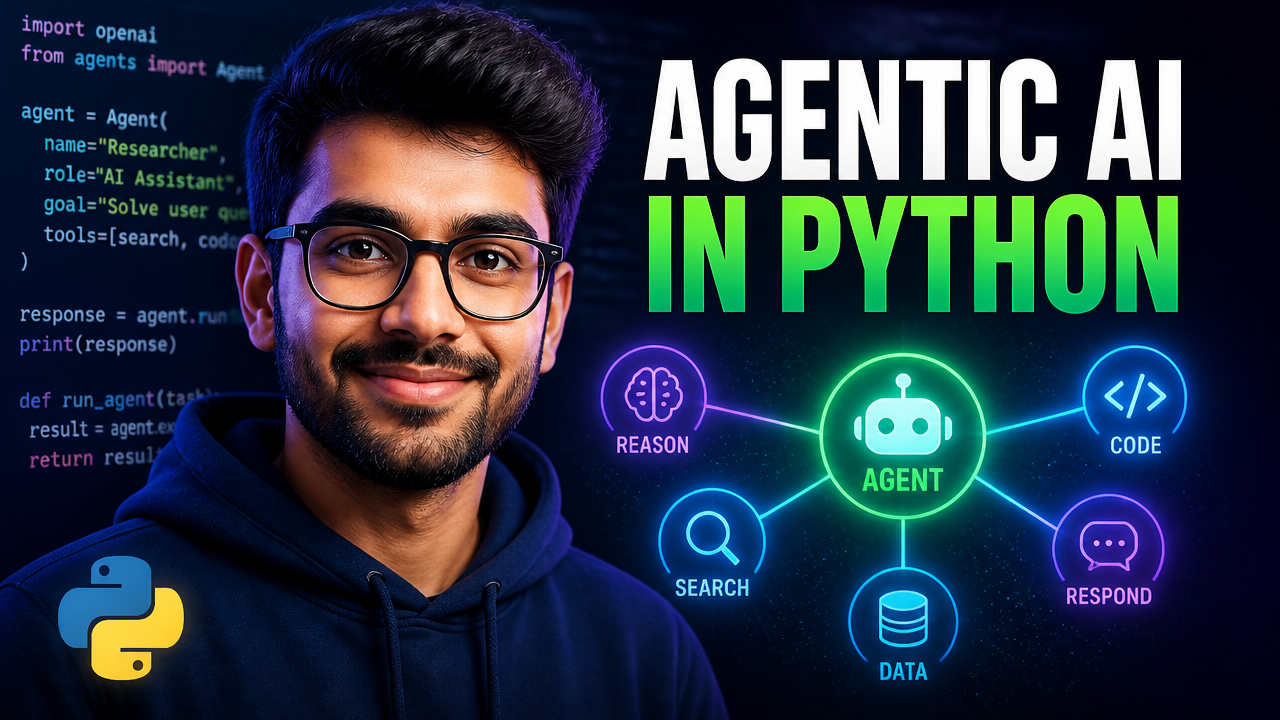
This is the home base for Agentic AI in Python: Zero to Production — a six-part, build-along series. You start with a bare Python script and finish with an agent that reasons, calls real tools, remembers context, runs as a deployed service, and tells you when it breaks.
Each part picks up exactly where the last one left off, so the fastest path is to start at Part 1 and work forward.
What you’ll build#
By the end of the series your agent can:
- Think — a LangGraph agent loop that reasons and calls tools (Part 1)
- Serve — wrapped in a FastAPI service, containerised, and deployed (Part 2)
- Coordinate — split work across a multi-agent structure (Part 3)
- Remember — persist context across turns with a real checkpointer (Part 4)
- Act — call live tools over an MCP client, with authentication (Part 5)
- Be measured — traced and scored against a fixed test set so regressions surface early (Part 6)
The series, in order#
- Part 1 — Tools, StateGraph & Memory — Build a working local agent in Python with LangGraph: tools, a StateGraph loop, and a SQLite checkpointer. This is the foundation every later part builds on.
- Part 2 — FastAPI, Docker & Deploy — Put the agent behind an HTTP API with FastAPI, containerise it with Docker, and deploy it so you can call it from anywhere.
- Part 3 — Multi-Agent Systems — Split the work across specialised agents that hand off to each other, and learn when multi-agent actually beats a single agent.
- Part 4 — AI Agent Memory — Give the agent durable memory so it remembers context across turns and sessions with a production checkpointer.
- Part 5 — MCP Client & Real Tools — Wire the agent to real tools over the Model Context Protocol, with authentication and basic guardrails against prompt injection.
- Part 6 — Observability & Evals — Trace every run and tool call with Pydantic Logfire, then score the agent against a fixed test set so you catch regressions before users do.
How to use this series#
- New to agents? Read What Are AI Agents? first for the concepts, then come back to Part 1.
- Just want a running agent? Parts 1–5 are cumulative — follow them in order.
- Already have an agent? Jump straight to Part 6 to make it observable and testable.
Pick up at Part 1 below, and subscribe to the RSS feed so new parts land in your reader.