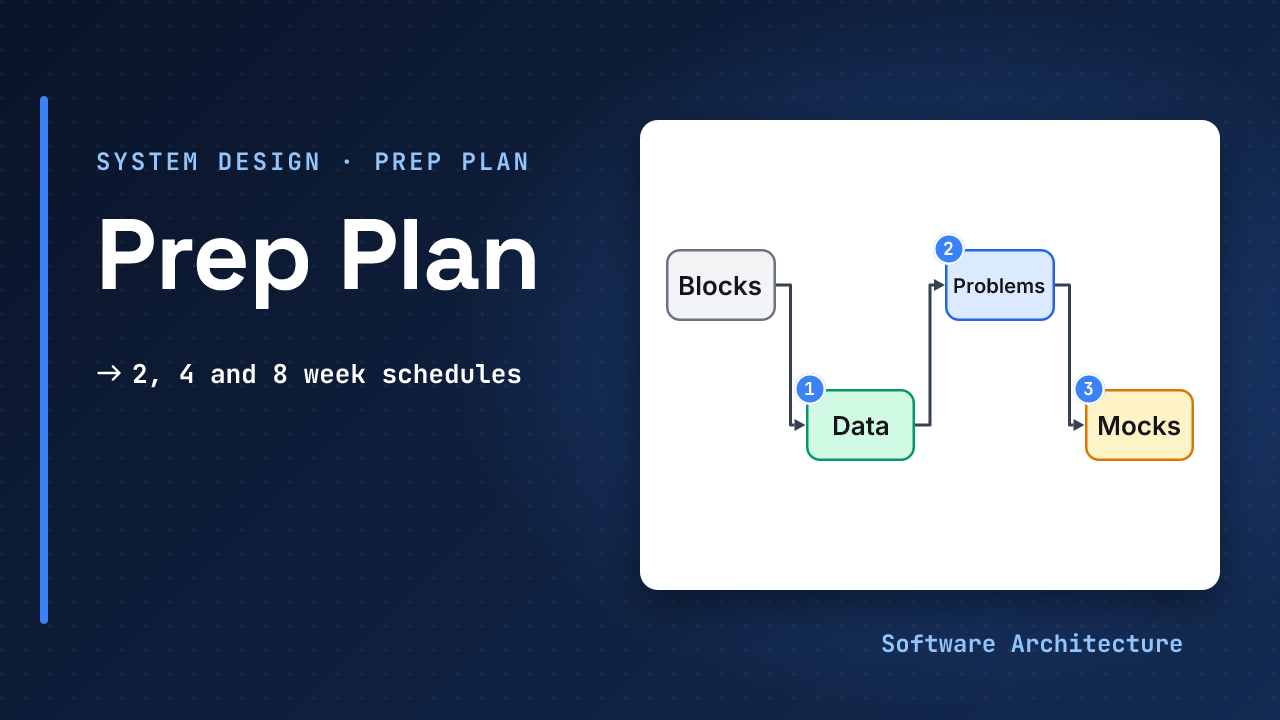
Picture a candidate with three weeks and a list of thirty lessons. She reads one a day, understands each, and has never drawn a design under a timer. In the room the first diagram takes ten minutes, and the interviewer is still waiting for requirements.
The gap is not knowledge. It is the schedule. Reading is easy to schedule, so it takes every hour. The skills the round scores (drawing from memory, talking while drawing, finishing on time) get none.
This capstone is a schedule that fixes the ratio. It covers four plan lengths, the lesson order for each, a daily rhythm, a review routine and the final-week checklists. The mock interview practice guide owns the drill routine and the scoring rubric, so every mock below points there. Employer facts were checked on October 24, 2026.
- You know your interview date, or a rough guess.
- You have built or maintained a backend service. The framework lesson is the first item in every plan below.
Which two of the six framework steps get the most minutes? High-level design and the deep dives, about 13 minutes each of the 45.
- A plan is hours split four ways: learn, draw from memory, mock, review. Reading should be under half.
- Pick the shortest plan whose reading list you can finish with a week to spare for review.
- Review at widening gaps (about 1, 3, 7, 14 days) and score every topic 1 to 4 on a tracker.
- Employers publish little. Treat anything beyond their pages as “varies by team”, and ask the recruiter in writing.
- Plans fail from passive reading, no mocks and too many resources, not from too few hours.
Choose a 3-day, 2, 4 or 8 week plan for your level, fill it with named lessons, mocks and review dates, and know what to change when a week goes wrong.
Which Level Are You Preparing For?#
Level decides how much of the round you must drive, so it decides what to practise. The framework lesson sets out who drives at each level. The last column below is this plan’s judgement.
| Target | The round expects | Add to the plan |
|---|---|---|
| Mid | Follow the interviewer, cover the basics | Building blocks, four classic problems |
| Senior | Drive, and propose the deep dives | Data, messaging, failure modes |
| Staff | Drive and widen: cost, regions, operability | All of it, plus one mock on a vague prompt |
Now pick a track. Count how many rows are true for you today. Two or more means choose the longer plan in the next section.
| True today | Weak area | Spend extra on |
|---|---|---|
| I run past 45 minutes | Pacing | Timed drills, mocks |
| I name parts but not why | Choices | Building blocks, SQL vs NoSQL |
| ”What if X fails?” stalls me | Reliability | Failure modes |
| I skip the numbers | Estimation | Estimation primer |
| I design well but silently | Speaking | Mock review |
How Many Weeks Do You Have?#
Hours are announced assumptions, not research. Assume a working engineer with a full-time job.
| Plan | Hours | Suits | Drops |
|---|---|---|---|
| 3 days | 5 a day | Interview is imminent | Everything but the core path |
| 2 weeks | 12 a week | Already designs at work | Deep messaging, half the problems |
| 4 weeks | 8 a week | Most people | Video, ride sharing, crawler, typeahead |
| 8 weeks | 6 a week | Level stretch, long gap | Nothing, adds mocks |
3 days  x 5 h  = 15 h
2 weeks x 12 h = 24 h
4 weeks x 8 h  = 32 h
8 weeks x 6 h = 48 hOf an 8-hour week, how many minutes should go to reading new lessons? Guess, then check the daily rhythm below.
What to Read, in What Order#
Read components before the problems that use them. A feed design is easier once caching and fan-out are familiar. Each lesson shows the time in minutes printed on its own page. Each list below is added to the one before it, so the 8-week plan includes all three.
In the 2-week core
- Building blocks: Framework (20 min), estimation (20 min), blocks (35 min), caching (30 min), load balancers (30 min)
- Data and messaging: SQL vs NoSQL (45 min), CAP (30 min), sharding (25 min), events (35 min), delivery (30 min)
- Classic problems: URL shortener (35 min), news feed (40 min), chat (40 min)
- Reliability: Failure modes (30 min)
Added at 4 weeks
- Data and messaging: Consistent hashing (25 min), Kafka vs RabbitMQ (35 min)
- Classic problems: Rate limiter (40 min), notifications (40 min), file storage (40 min)
- Reliability: Follow-ups (30 min)
- AI systems: LLM design (35 min)
Added at 8 weeks
- Building blocks: Rate limiting (35 min), CDNs and object storage (40 min), API gateways (35 min), scaling (40 min)
- Data and messaging: Monolith vs microservices (35 min), ordering (25 min)
- Classic problems: Crawler (40 min), typeahead (35 min), video (45 min), ride sharing (45 min)
- AI systems: AI gateway (35 min), agents (35 min)
Three names need a gloss: sharding, a CDN and consistent hashing. Add the minutes (all in the table’s own numbers):
2 weeks: 445 min (14 lessons)
4 weeks: 445 + 245 = 690 min
8 weeks: 690 + 445 = 1,135 min
The 3-day path is a subset: framework, estimation, blocks, caching, URL shortener, chat and failure modes, 20 + 20 + 35 + 30 + 35 + 40 + 30 = 210 minutes. Each problem also has a follow-ups lesson (linked from the problem). Read those only for problems you will likely be asked.
The Daily Rhythm: Learn, Draw, Mock, Review#
Every session has the same four beats. Close the lesson, then draw the design from memory: that step, not the reading, is the practice. Retrieval practice means pulling an answer out of memory instead of looking at it again.
Assume 60 minutes on weekdays and 180 on the weekend (8 hours in all):
| Block | Weekday | Weekend |
|---|---|---|
| Learn | 30 min, one lesson | Sat: 40, one problem lesson |
| Draw | 20 min, redraw and say the trade-offs | Sat: 30, redraw it |
| Review | 10 min, tracker rows due today | Sat: 20, Sun: 15 |
| Mock | None | Sun: 45 round + 30 review |
Learn:  5 x 30 + 40 = 190 min
Draw:   5 x 20 + 30 = 130 min
Review: 5 x 10 + 20 + 15 = 85 min
Mock:   45 + 30 = 75 min
Total:  480 min = 8 h
That answers the prediction: learning is 190 of 480 minutes, call it 40%. A lesson longer than 30 minutes spills into the draw block; finish the drawing on Saturday. For the mock itself (how to run it, how to score it), follow the mock interview practice guide.
The Week-by-Week Schedules#
The 4-week plan below is the default. Its four weeks have one focus each, and a mock every Sunday.
| Wk | Mon to Fri, learn block | Sat, Sun |
|---|---|---|
| 1 | Framework, estimation, blocks, caching, load balancers | Shortener lesson; Mock 1 cold |
| 2 | SQL vs NoSQL, CAP, sharding with hashing, events, delivery | Rate limiter lesson; Mock 2 shortener |
| 3 | News feed, chat, notifications, file storage, Kafka vs RabbitMQ | Redraw two weakest; Mock 3 feed |
| 4 | Failure modes, follow-ups, LLM design, then redraw weakest | Checklists; Mock 4 unseen prompt |
Reading in that table: 170 + 230 + 195 + 95 = 690 minutes (the 4-week total above) against 4 x 190 = 760 learn minutes, so 70 are spare. Mock 1 is cold on purpose: a weak result in week 1 tells you where to spend the next three weeks.
The other lengths:
| Plan | Schedule |
|---|---|
| 3 days | Day 1: framework, estimation, blocks, caching, redraw each. Day 2: shortener, chat, Mock 1. Day 3: failure modes, Mock 2, checklists |
| 2 weeks | Wk 1: the first 8 core lessons plus the shortener, Mock 1 cold. Wk 2: the other 5, then Mocks 2 to 4 on the shortener, the feed and an unseen prompt |
| 8 weeks | Wk 1-2 blocks. Wk 3-4 data and messaging. Wk 5-6 ten problems. Wk 7 reliability and AI. Wk 8 rehearse |
Mocks: 2, 4, 4 and 7 for the four plans, with Mock 1 in week 1 and then weeks 3 to 8 for the 8-week plan. Run each on a problem you have not drawn in the last five days, or a new prompt from a peer. These counts are judgement.
When a Week Goes Wrong: Re-Plan Rules#
Plans slip. Decide the rule now, so a bad week does not become a rewrite. These rules are judgement.
| Situation | Do this |
|---|---|
| Behind by 1 or 2 days | Cut the learn block that day; keep draw and review |
| Behind by a week | Move to the next shorter plan’s list, keep every mock |
| Mock score fell | Redraw that problem tomorrow and on day 3 |
| Ahead of plan | Add a mock, not a lesson |
The order of what to protect is: mocks, then drawing, then review, then new lessons.
Spaced Review: Why the Gaps Widen#
Two papers shape the review routine. Cepeda and colleagues pooled 839 assessments of distributed practice from 317 experiments in 184 articles, and found that the best gap between study sessions grew as the time until the test grew (Cepeda et al.).
Roediger and Karpicke had students read prose passages, then either restudy or take recall tests. Restudying won on a test 5 minutes later. Testing won after 2 days and 1 week, even though restudying left students more confident (Roediger and Karpicke).
Both used word lists and prose passages, not engineering skills. They support two habits: space the reviews, and test yourself instead of rereading. They do not give exact intervals, so the ladder below is judgement.
The tracker sets the next date from your confidence score (judgement):
| Score | Meaning | Next review |
|---|---|---|
| 1 | Cannot start | Tomorrow |
| 2 | Recall with gaps | In 3 days |
| 3 | Redraw and explain trade-offs | In 7 days |
| 4 | Redraw in 5 minutes, answer 2 follow-ups | In 14 days |
Drop any review that falls in the last 2 days. In a 2-week plan the ladder stops at day 7, which is one reason short plans retain less.
Problem Order, Easy to Hard#
Each problem below reuses an earlier one, so the order is part of the method. The “trains” column comes from the course’s own problem notes.
| # | Problem | What it trains |
|---|---|---|
| 1 | URL shortener | ID generation, read-heavy caching, the full framework |
| 2 | Rate limiter | Token bucket, shared counters |
| 3 | News feed | Fan-out on write vs read, ranking |
| 4 | Chat | WebSockets, ordering, presence |
| 5 | Notifications | Queues, retries, dedupe |
| 6 | File storage | Chunking, sync, object storage |
| 7 | Crawler | Frontier queue, politeness, dedupe |
| 8 | Typeahead | Tries, caching, ranking |
| 9 | Video streaming | CDN, transcoding pipeline |
| 10 | Ride sharing | Geospatial indexing, matching |
What Employers Say, as of 2026-10-24#
Employers publish little, and most of it is thin. The table holds only what each page states. For anything else, the honest label is varies by team.
| Employer | What its page states | Source |
|---|---|---|
| Amazon | SDE II loop: four 55-minute interviews; SDE III: five. At least one software systems design question. Leadership Principles take a significant share | SDE II, SDE III |
| Microsoft | The round is a short 45 minutes. Ask clarifying questions and plan first. Distributed systems knowledge is “very important” for design | Technical interviewing |
| Meta | Process usually takes about 2 to 3 months. Its page says design interviews are held in CoderPad with Mermaid Markdown and the coding round’s AI assistant, for select roles | Hiring process |
| Google, Apple | No official page with interview details could be read. Varies by team | None |
Three details matter. Meta’s page says select roles include an authorised AI assistant, that candidates are expected to use it, and that no outside AI tools are authorised. It does not say which roles or levels this covers, and candidate accounts differ on whether a particular design round actually had the assistant, so confirm yours with the recruiter. An older Meta post (October 2022) calls the design round 45 minutes, systems or product (Meta), which fits the framework’s clock.
Reports are weaker than pages. 404 Media reported in July 2025 that Meta would let some coding candidates use an AI assistant (404 Media). In May 2026 Business Insider reported a Google pilot for junior and mid-level candidates on select US teams, in a code-comprehension round (Miami career center, summarising the report). Both concern coding rounds. Practise with and without an assistant, and ask for each round’s rules in writing.
The Last Week and the Day Before#
- Stop new lessons 5 days out. Only review and mock.
- Run two mocks, one with a peer on a prompt you have not seen.
- Redo the estimation drill for three systems.
- Review only tracker rows scored 1 or 2.
- Ask the recruiter in writing: format, tools, AI rules, length, interviewer role.
- Test the setup: shared doc, diagram tool, camera, audio.
The day before is light: redraw two designs for 20 minutes each, rehearse the first minute (your opening questions), recite the five estimation numbers, pack, sleep. No new topics.
On the day, use time checks from the framework’s boxes: requirements done at minute 5, API at 12, a working design at 25, deep dives finished at 38, wrap-up at 43 (5 + 2 + 5 + 13 + 13 + 5, with 2 spare). Glance at a clock at each.
Practise the tool. If the round uses a text diagram format, such as Mermaid (named on Meta’s page above), rehearse it:
flowchart LR
  C[Client] --> S[Service]
  S --> D[(Database)]
  S --> K[(Cache)]
Also test camera and audio the evening before, keep water in reach, and keep a visible clock. All of this is judgement, not an employer rule.
The One-Page Tracker#
One row per topic. Days count from day 0 of the plan. The rows below apply the score table: 1 means tomorrow, 2 in 3 days, 3 in 7, 4 in 14.
| Topic | Score | Last | Next |
|---|---|---|---|
| Estimation | 4 | d3 | d17 |
| Caching | 3 | d4 | d11 |
| CAP | 2 | d6 | d9 |
| Delivery guarantees | 1 | d9 | d10 |
| URL shortener | 2 | d7 | d10 |
How Plans Fail, and What Saves You#
| Failure | Symptom | What saves you |
|---|---|---|
| Passive reading | Follows a lesson, cannot redraw it | No lesson counts as done until redrawn |
| No mocks | First timed run is the interview | Book Mock 1 in week 1 |
| Skipping estimation | Numbers appear late or never | One 1-minute estimate per problem |
| Over-collecting | Forty tabs, three plans | This page is the list; swap, never add |
| Burnout | Missed days pile up | Cut the learn block, keep draw and review |
Rereading. It feels productive and, per the retrieval research above, helps less on a delayed test than testing yourself does. Close the page and draw.
Do not follow this plan for a low-level or object-oriented design round, which the framework lesson excludes, or when a recruiter gives you a topic list. The list wins.
Two weeks versus eight weeks is a trade-off:
| 2 weeks | 8 weeks | |
|---|---|---|
| Hours | 24 | 48 |
| Spacing | Ladder stops at day 7 | Full ladder, repeated |
| Main risk | Shallow data and messaging | Drift and fatigue |
| Mocks | 4 | 7 |
Recommendation: pick the shortest plan whose reading list fits with a week spare for review. For most working engineers that is 4 weeks. If you have 8, use the extra time for mocks and review, not for more resources.
Try It: Build Your Own 4-Week Schedule#
Constraints: 8 hours a week, a senior target, weak on messaging, evenings Monday to Thursday of 90 minutes and Sunday 120. Produce:
- The weekly minutes for learn, draw, review and mock.
- The four-week total in hours.
- The reading list, and whether it fits.
Hint
Check the week first: 4 x 90 + 120 must equal 480. Then split each evening into learn, draw and review.
One reasonable answer
Evening 90: learn 40,
  draw 35, review 15
Sunday 120: mock 75,
  redraw 30, plan 15
Learn:  4 x 40 = 160
Draw:   4 x 35 + 30 = 170
Review: 4 x 15 + 15 = 75
Mock:   75
Week:   160+170+75+75 = 480
4 wks:  480 x 4 = 1,920 min
        = 32 h
Reading list: framework, estimation, blocks, caching, load balancers (135 min), the four messaging lessons (125), SQL vs NoSQL, CAP, sharding (100), shortener, feed, chat, notifications (155) and failure modes (30). That is 545 minutes against 4 x 160 = 640 learn minutes, so 95 are spare. Messaging goes in week 1 so it can be reviewed on days 1, 3, 7 and 14. Dropped: rate limiter, file storage, AI.
Variations: mid-level drops Kafka vs RabbitMQ and the failure follow-ups. Senior is the plan above. Staff adds the LLM and AI gateway lessons and one mock on a deliberately vague prompt.
1.In a 480-minute week, about how many minutes go to learning new material?
190, about 40%. The other 60% is drawing from memory, review and the mock.
2.A topic scores 2 on day 6. When is the next review?
Day 9, three days later, per the score table. If day 9 falls inside the last 2 days before the interview, skip it.
3.The interview moves from 4 weeks away to 2. What changes?
Use the 2-week list (445 minutes), keep Mock 1 in week 1, and drop the day 14 review. Add hours before you add lessons.
4.Your recruiter says nothing about AI tools. What do you do?
Ask in writing for each round. Public pages differ by employer, so treat the rule as unknown until you have it.
Tonight, open the tracker and fill the first five rows from memory, with a score for each. The rows you cannot fill tell you where week 1 goes.
In One Picture#
Plan: shortest that fits + 1 week
Hours: learn 40%, rest drill
Daily: learn 30, draw 20,
  review 10
Weekly: one mock
Review: day 1, 3, 7, 14
Employers: only what pages say- Run the drills: the mock interview practice guide owns the routine and the scoring rubric.
- Start the plan: open with the framework lesson and the estimation primer.
- Reliability and AI rounds: failure modes and the LLM system design guide.